Your Ultimate Wuhan Travel Guide — Licensed English Guides for Yellow Crane Tower, East Lake & More
8,494 km²
13.6 million
Wuhan (武汉) means "Military + Milky Way". Formed by merging Wuchang, Hankou, and Hanyang in 1927. Known as the Thoroughfare of Nine Provinces.
7.0/10 — A riverside city where three towns meet — residents enjoy the famous "过早" breakfast culture and lakeside walks.
Airport: Wuhan Tianhe (WUH) — 3 terminals, 45 min to city center by Airport Bus (¥25) or Metro Line 2. Train Stations: Wuhan Railway Station (high-speed rail, 30 min to Yellow Crane Tower), Hankou Railway Station (city center, 20 min to Jianghan Road), Wuchang Railway Station (near universities). Metro: 11 lines. Unique: The city is divided by the Yangtze and Han rivers into three towns: Wuchang, Hankou, and Hanyang.
Wuhan University, HUST, China University of Geosciences, CCNU
East Lake (largest city lake in China), Yangtze River, Han River, Mulan Mountain, Tianxingzhou, Donghu Greenway.
Plan your perfect Wuhan trip with our seasonal guide — weather, events, and travel tips for every time of year.
Autumn (September–November) — the best season to travel to Wuhan
Winter (December–February) offers budget-friendly accommodation with fewer tourists
Mar–May: Spring | Jun–Aug: Summer | Sep–Nov: Autumn | Dec–Feb: Winter
Discover the best of Wuhan with a knowledgeable local expert who speaks fluent English.
Licensed, verified, and passionate about showing you the best of Wuhan.
Licensed, experienced English-speaking guide in Wuhan. Deep knowledge of local history, culture, and attractions. Fluent English with professional guiding certification. Available for half-day, full-day, and multi-day tours.
Friendly, personable local guide in Wuhan. Basic English with translation app support. Perfect for shopping tours, food walks, and casual city exploration. Great value for budget-conscious travelers.
Metro, taxi, ride-hailing, train & bus — everything you need to get around Wuhan easily.
Get 武汉通 card for metro + bus. Official app: 武汉地铁. Key: Lines 2 & 4 (to Yellow Crane Tower/East Lake). Runs 6am-11pm.
Wuhan Metro Map →Starts CNY 10 for 3 km, CNY 2/km thereafter. Very affordable. All metered. Alipay/WeChat accepted.
Book via DiDi →Wuhan (武汉站) — main HSR hub: Beijing (4h), Shanghai (4h), Guangzhou (4h), Chengdu (7h). Wuchang (武昌站) — classic lines. Hankou (汉口站) — east-west lines.
Book Train Tickets →Wuhan Bus Hub (武汉宏基客运站) in Wuchang. Book via 携程 or at counter.
Search Bus Routes →HSR: 12306.cn. Wuhan has 3 stations far apart — double-check departure station before booking.
Book on Trip.com →Wuhan nightlife is lively and unpretentious — locals eat late and the city loves a good night market. Here where to join them after dark.
Wuhan has a legendary music scene — the city has produced some of China's biggest rock and indie bands. Add opera, symphony, and a vibrant club scene, and Wuhan is one of central China's entertainment capitals.
Wuhan is home to some of China's most fascinating tea traditions - from historic tea houses to famous local varieties and time-honored brewing rituals.
Wuhan hosts major national and international sporting events throughout the year - from world-class marathons to professional tournaments.
Local drivers for airport pickup, attraction transfers & private car charter. Safe, reliable, English-speaking support.
Book on ChinaWheely →Unlimited 5G pocket WiFi delivered to your hotel. No Chinese ID needed. Full Google, WhatsApp & Instagram access.
Pre-Order WiFi →Health checkups, dental cleaning & more. Much cheaper than in US/Europe. Add a wellness stop to your trip.
Learn More →The Chinese zodiac (十二生肖) features 12 animals — Rat, Ox, Tiger, Rabbit, Dragon, Snake, Horse, Goat, Monkey, Rooster, Dog, Pig. Each sign's personality shapes the ideal travel style for Wuhan. Find your zodiac sign for personalized Wuhan travel recommendations!
Common questions about hiring an English guide in Wuhan.
Wuhan English private tour guides from VIPChinaGuide start from ¥585 ($80 USD) for 3 hours with an Escort Guide, and ¥878 ($120 USD) for an Expert Guide. Full-day tours (8 hours) range from ¥1,167 to ¥1,716. Prices include the guide's service only; entrance tickets and meals are separate.
Yes, you can book an English-speaking guide for Wuhan online before arriving in China. VIPChinaGuide accepts bookings online with secure payment. We recommend booking at least 3-7 days in advance, and 2-4 weeks ahead for peak seasons. Contact us on WhatsApp at +86 155 2777 1775 for last-minute requests.
The best time to visit Wuhan depends on your preferences. Spring (March-May) and autumn (September-November) generally offer the most pleasant weather across most of China. Summer can be hot but is great for festivals and outdoor activities. Winter offers fewer crowds and lower prices. Your guide can help you plan the perfect itinerary based on the season.
While you can explore Wuhan independently, a local English-speaking guide adds immense value: they handle Chinese-only signage and menus, help you avoid tourist traps, provide historical and cultural context, know the best photo spots and local restaurants, and can assist with transportation and bargaining. A guide transforms sightseeing into an immersive cultural experience.
We recommend booking at least 3-7 days in advance for Wuhan. For peak seasons (Chinese New Year, Golden Week, summer holidays), book 2-4 weeks ahead. Our top expert guides are often booked well in advance. For last-minute requests, contact us on WhatsApp at +86 155 2777 1775 and we will do our best to accommodate.
Book your licensed English-speaking private guide today. Experience Wuhan like never before with a local expert.
Book Your Wuhan Guide NowEvery route includes in-depth cultural and historical explanations from your private English-speaking guide
Explore the city where the Yangtze and Han Rivers converge, home to China's most famous tower and a revolutionary history that shaped modern China.
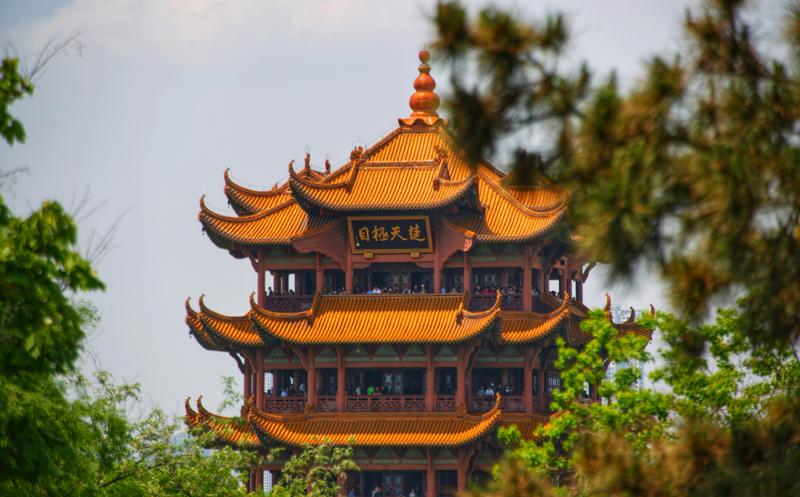
First built in 223 AD and rebuilt 27 times over 1,800 years, this 51-meter tower is the most celebrated in Chinese poetry with over 1,000 poems written about it. Your guide recites Cui Hao's 8th-century masterpiece inscribed on the tower walls, explains the Daoist legend of an immortal riding a yellow crane that gave the tower its name, and leads you to the observation deck for panoramic views of the Yangtze River and Wuhan's three districts connected by bridges.
China's largest urban lake at 33 square kilometers — five times the size of Hangzhou's West Lake. Your guide arranges a boat tour past the Cherry Blossom Garden with 10,000 trees imported from Japan in the 1970s, explains the Hubei Provincial Museum's collection of 240,000 artifacts including the 2,400-year-old Zenghouyi bronze bells that still produce perfect pitch across five octaves, and points out where Mao Zedong swam across the lake 43 times between 1956-1966.
The first bridge across the Yangtze River, completed in 1957 after Soviet engineers and 100,000 Chinese workers labored for two years. Your guide explains how the bridge's dual-deck design carries both trains and vehicles, the symbolism of finally connecting China's north and south by rail after 2,000 years of ferry crossings, and the 16,000 granite stones used in its construction, each weighing 1.5 tons.
Walk the streets where the Xinhai Revolution began, toppling 2,000 years of imperial rule and establishing Asia's first republic.
The former Hubei Military Governor's Office where revolutionaries launched the Wuchang Uprising on October 10, 1911, triggering the Xinhai Revolution that ended China's imperial system. Your guide explains how a prematurely exploded bomb accidentally revealed the revolutionary plot, forcing the rebels to act early, and how this chaotic uprising succeeded against all odds to establish the Republic of China under Sun Yat-sen.
A 7-kilometer riverside park built on the historic foreign concessions where British, French, Russian, German, and Japanese powers controlled separate districts from 1861-1943. Your guide points out the Russian Orthodox church, the French consulate, and the German bakery that still uses 150-year-old recipes, explaining how Wuhan became China's second treaty port and a battleground for foreign influence.
A 350-year-old Buddhist temple famous for its 500 Arhat statues — each with unique facial expressions, postures, and stories from Buddhist scriptures. Your guide explains the tradition of counting arhats to predict your fortune, points out the arhat whose face was modeled on a Qing Dynasty emperor as a hidden political joke, and shares the temple's role as a refuge for 20,000 civilians during the 1938 Battle of Wuhan against Japanese invasion.
Everything you need to plan your Wuhan trip — visas, best time to visit, transport tips, and budget advice — all in one place.
Book a Wuhan Guide →